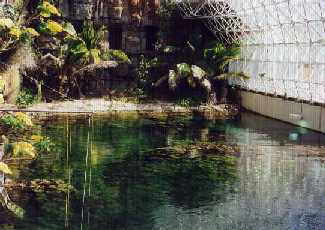
But the facts are plain and uncontestable: the biosphere is finite, nongrowing, closed (except for the constant input of solar energy), and constrained by the laws of thermodynamics. Any subsystem, such as the economy, must at some point cease growing and adapt itself to a dynamic equilibrium, something like a steady state.
The article referenced John Stuart Mill's theories concerning a stationary state, and I'm hoping someone can enlighten me regarding those thoughts. A bit further is what I consider Daly's most quotable quote...
 Because establishing and maintaining a sustainable economy entails an enormous change of mind and heart by economists, politicians and voters, one might well be tempted to declare such a project would be impossible. By the alternative to a sustainable economy, an ever growing economy, is biophysically impossible. In choosing between tackling a political impossibility and a biophysical impossibility, I would judge the latter the more impossible and take my chances with the former.
I think Daly may be setting up a false dichotomy, as his separation of growth and development makes his argument unnecessarily argumentative. Wealth as sought by economic growth should be achievable through economic development, since the throughput won't inevitably remain entropy-neutral. Still, this has it's own assumption: Can production add value to total capital without depleting natural resources?
Illustration Credited to Matt Collins from the article discussed.